FINANCIAL TIMES INTERVIEW WITH FELICITY KENDAL
Posted on 10 December 2025.
Posted in: Main Stage
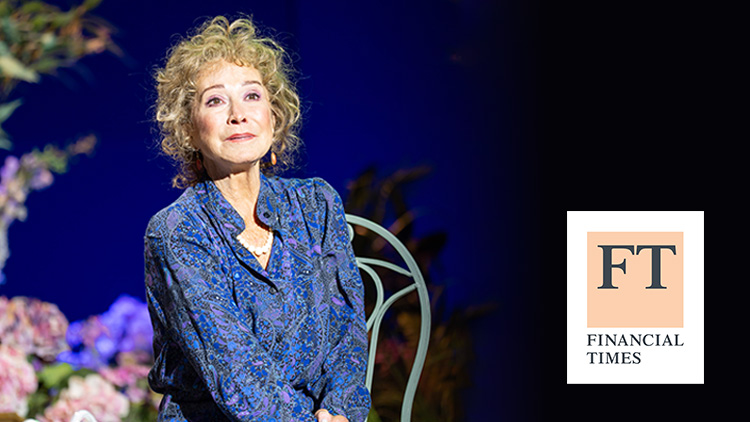
As Felicity Kendal stars in Indian Ink she reflects on a life in the theatre with Sarah Hemming, Theatre Critic.
“It’s like going home,” says Felicity Kendal, as she takes a seat in a Hampstead Theatre dressing room. “And it’s one of the few plays I thought when I was doing it, ‘Ooh, I could come back to this.’”
The play in question is Tom Stoppard’s Indian Ink, a drama which like so much of the great playwright’s work swings across time periods, blurring the edges between past and present, playing out events and then refracting them through memory.
In Indian Ink, we switch between 1930s India, where a free-spirited poet, Flora Crewe, forges a relationship with a painted, and 1980s England, where her sister, Mrs Swan, fends off a beady would-be biographer of the now deceased Flora.
Kendal is returning to the play 30 years after appearing in its premiere. That together with the Indian backdrop, and the fact that this north London theatre is where she met her late partner, Michael Rudman, already, makes it a revival charged with emotion. For her, it’s going home on multiple levels.
But time, in this case, has a further trick of its own. Just five days after we meet comes the news that Stoppard has died. In the midst of technical rehearsals, the Indian Ink company learns the news.
“It was as if all the lights had dimmed,” Kendal tells me, by email. “Such a contrast to the first days of work that were filled with excitement at being in this wonderful play. We [had still been] hopeful that he would make it into rehearsals. He was a joy to work with, a hard taskmaster – nothing got by his razor-sharp wit – and the kindest of men, with a beautiful sense of humour. A loyal friend, a gentle genius.”
Looking back, what was a conversation already steeped in reflection takes on another layer, making one even more aware of Stoppard’s rare brilliance in holding up to the light the brevity of life.
Back then to that dressing room, where Kendal has arrived fresh from rehearsals: tiny, trim and buzzing with energy. In 1995, she played Flora: young, scandalous and fiercely independent. This time she’s Mrs Swan, who may be decades older but is every bit her sister’s match. “Mrs Swan is, in her way, as racy as Flora,” Kendal says, with delight. “She’s a wonderful character.”
She also has some cracking lines. As the eager, wannabe biographer advances fanciful theories about a reference in Flora’s letters to “the Queen’s Elm”, she stops him with a withering put-down: “It’s a pub in the Fulham Road.”
I can imagine Kendal delivering that with splendid finality. “I do love a good line,” she agrees. “Mrs Swan is my idea of heaven.”
But this being Stoppard, that pithy exchange sums up the much deeper ironies. The play’s double timeframe allows audiences to piece together patterns the characters cannot see. And rumbling in the background are Indian independence and the end of the British empire.
“It’s very honest about the British,” says Kendal. “But it’s not a political play. And what does come across, the more we do it, is that it is like a love letter to India. For me it’s very evocative: it’s the language of where I grew up.”
India, for Kendal, is intimately entwined with all her earliest memories (Stoppard too lived there as a child). Born in 1946, she had a wildly unconventional childhood, travelling the length and breadth of the country with her father’s acting troupe. “It was a wonderful education,” she recalls. “Everyone was different — they had different needs and different loves, different religions and different beliefs. But we got on a train and went and did the job. I can’t remember any hostility.”
They’d perform in palaces, convents, schools and squares, sleeping on trains – “half my life was spent on trains” – and even station platforms, all of it against the tumultuous political backdrop of postcolonial India. It left her with a life-long love of the place and the people, a nomadic instinct, a deep commitment to drama, the spirit of a trouper and a restless urge to work. “Every single time I’ve done something in the last 10 years, I’ve thought, ‘Well, I’m not doing this any more!’” she says, laughing. “It’s all-consuming, it’s exhausting, the possibility of disaster is always there. And then, when I stop, I think, ‘What am I going to do now?’”
To read the full interview visit the Financial Times below
Indian Ink plays the Main Stage until 31 January.